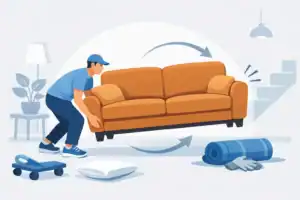
You usually find out whether one person can move a sofa at the worst possible moment – halfway through a doorway, with one arm pinned, the wall scuffed, and your back already warning you to stop. A sofa can look manageable when it is sitting still in the living room. Once it has to turn, lift, clear stairs, or fit through a tight hall, the job changes fast.
Can one person move a sofa?
Sometimes, yes. Sometimes, absolutely not. That is the honest answer.
If it is a small two-seater, fairly light, and you are only moving it across a flat room or straight out to a van with easy access, one person may be able to do it with the right technique and a bit of patience. If it is a bulky recliner sofa, a sleeper sofa, a deep corner unit, or anything going up and down stairs, the risk goes up quickly.
The real issue is not just weight. Shape matters as much as pounds. Sofas are awkward, wide, and hard to grip. A piece that is technically light enough to lift can still be difficult to control, especially around landings, narrow doors, and apartment hallways.
That is why people get caught out. They think, I can deadlift this much, so I can move the sofa. But moving furniture is not gym lifting. It is lifting while twisting, balancing, pivoting, and trying not to damage the walls.
When one person can move a sofa safely
A single person has a decent chance if the sofa is compact, the route is short, and there are no awkward access points. A basic loveseat, a small apartment sofa, or a lightweight frame with removable cushions is far easier than anything overstuffed or mechanical.
Ground-floor moves are also a different story from stair moves. If you are sliding the sofa across hard flooring, then loading it into a vehicle parked close by, one person may manage the job with furniture sliders, moving straps, and some preparation.
It also helps if the sofa can be stripped down a bit. Removing cushions, legs, and detachable parts can make a surprising difference. Sometimes that is the difference between a manageable lift and a bad idea.
The safest solo moves tend to have three things in common: good access, short distance, and a light enough sofa to control rather than just barely lift.
Signs it is probably manageable alone
If you can tilt one end without straining, the sofa fits clearly through the exits, and you are not dealing with stairs or steep outdoor steps, it may be realistic. If the path is clear and dry, and you have proper grip gloves or straps, your odds improve again.
Still, manageable does not mean easy. It just means possible without pushing your luck too far.
When you should not try to move a sofa alone
There are some situations where the answer to can one person move a sofa is really no, not safely.
Sleeper sofas are a common trap. They often look like regular couches but carry hidden weight from the metal bed frame inside. Reclining sofas are another one. The mechanisms add bulk and make the weight uneven, which makes the piece harder to control.
Stairs are where many solo moves go wrong. Even a relatively small sofa becomes dangerous when the weight shifts mid-step. The problem is not just dropping it. It is getting pinned between the sofa and the wall or losing footing while trying to save the piece from damage.
Tight turns are another red flag. A sofa that looks like it should fit can still jam at the corner because of arm height, back depth, or ceiling angle. If you have to lift, twist, and rotate all at once, that is not a one-person job.
And then there is vehicle loading. Getting a sofa into a van is not the same as moving it across a room. The height of the load area, the angle of the lift, and the final push inside all make it harder. If the van has an extra-high roof, access matters too. For example, high-roof vans cannot get into underground parking garages or basement loading areas, so that part needs checking in advance.
How to move a sofa alone with less risk
If you have looked at the route and you are still confident it is a reasonable solo move, preparation matters more than strength.
Start by clearing the full path, not just the area around the sofa. Remove rugs, shoes, side tables, and anything else that can catch your foot. Open doors fully and prop them if needed. Measure the sofa and measure the narrowest points on the route. Do not rely on guessing.
Take off whatever you can. Cushions, legs, and loose parts should come off before you lift anything. This makes the sofa lighter and less awkward. Wrap corners if you are worried about walls or door frames.
Then think about how you will move it. Sliding is usually better than carrying when the floor allows it. Furniture sliders can be a huge help on wood, tile, or laminate. On carpet, they may still help, but not always as smoothly.
When lifting is necessary, keep the sofa close to your body and avoid twisting under load. If you need to change direction, set it down first and reposition. That extra minute is better than pulling your back or smashing a corner into the wall.
Useful tools that actually help
A dolly can help, but only if the sofa balances well and the route is suitable. Moving straps can reduce strain, though they take a bit of setup. Gloves improve grip and protect your hands. Sliders are often the simplest and most useful tool for short indoor moves.
Blankets are worth having too. They protect the sofa when you lean it down temporarily and help prevent marks on floors and walls.
The mistakes people make most often
The biggest mistake is starting without testing the route. People focus on the sofa and forget the hallway, the front steps, or the turn at the bottom of the stairs.
Another mistake is trying to rush. Furniture moving goes badly when people get impatient and force a piece through a space that is too tight at the wrong angle. A sofa may fit, but only one way.
People also underestimate how tiring awkward lifting is. You might get the sofa out of the room, only to realize you have nothing left for the front steps or the van loading. Most moving injuries happen after that point, when grip gets weaker and decision-making gets worse.
And finally, many people wait too long to ask for help. If the sofa is halfway stuck and the walls are already marked, it is usually because the move should have been a two-person job from the start.
Is it cheaper to do it yourself?
Sometimes, yes. If the move is simple and you already have the right equipment, moving one sofa alone can save money.
But cheap can get expensive fast if something goes wrong. A damaged wall, a torn sofa base, or a strained back costs more than people expect. That is especially true in apartments and rentals where scuffs, dents, or damage to common areas can come back as repair charges.
There is also the time factor. What looks like a quick solo move can turn into an hour of awkward trial and error, then another hour trying to load it safely. For students, renters, or anyone moving a single item in a hurry, paying for a straightforward transport service often makes more sense than wrestling with it for half a day.
In places like Limerick, where a lot of moves involve apartments, student housing, and quick one-item pickups, this comes up all the time. A local man with a van service such as Man with a Van Seamus is often the middle ground between doing everything yourself and paying for a full removals crew.
When calling for help is the smart move
If the sofa is valuable, bulky, or heading through stairs and tight spaces, getting help is not overkill. It is simply practical.
The same goes for last-minute collections, marketplace purchases, or moves where you do not have your own transport. A sofa is one of those items that often seems easy right up until the point you have to get it home.
If you do hire help, you can make the job quicker and more affordable by preparing in advance. Clear the route, remove cushions and loose parts, and make sure any heavy furniture nearby is emptied if it also needs moving. Small bits of prep keep the job smoother and usually keep the cost down too.
A sofa does not care how motivated you are. It cares about weight, angles, grip, and access. If the move is short, flat, and simple, one person may be able to handle it. If it involves stairs, tight turns, hidden weight, or awkward loading, there is no shame in making the easy call before a simple move turns into a hard lesson.