
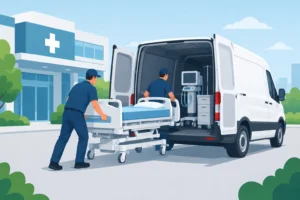
 A hospital-style bed, mobility aid, examination couch, or boxed medical device can be awkward to move even when it is only going a few miles. Moving medical equipment is not like collecting an ordinary chair or table: the item may be valuable, sensitive to bumps, or needed again quickly at its destination. A little planning makes the job safer and helps you choose the right type of transport.
For smaller, non-clinical moves around Limerick and nearby counties, a man-with-a-van service can be a practical option. The key is being clear about exactly what needs moving, its size and condition, and whether it has any special handling requirements.
What counts as medical equipment for a small move?
Medical equipment covers a wide range of items. Some are straightforward transport jobs, while others need specialist handling, temperature control, trained installation, or formal documentation. The difference matters.
A suitable small transport job may include a folded wheelchair, walker, shower chair, treatment table that can be safely carried by the people available, boxed supplies, a small examination stool, mobility equipment, or unopened medical furniture collected from a store or storage unit. It may also suit someone relocating personal equipment between an apartment, a family member’s home, a clinic room, or a short-term rental.
The job becomes more complicated when an item is connected to a patient, contains medication, requires calibration, has batteries with specific transport rules, or cannot be laid on its side. Equipment that needs dismantling, clinical cleaning, installation, testing, or specialist insurance should be handled by a provider set up for that work.
That is not a minor detail. Saving money on transport is worthwhile only if the equipment arrives usable and the move is appropriate for the item.
Start with the equipment, not the vehicle
Before booking transport, take a few minutes to assess the item. This prevents the common problem of discovering at collection that it will not fit through a doorway, cannot safely travel flat, or needs more people than expected.
Measure the length, width, and height of the equipment, including handles, trays, attached brackets, and packaging. Measure doorways, elevators, hallways, and the vehicle access point at both ends as well. A compact item can still be difficult if there is a narrow turn in an apartment building or a steep path from the parking area.
Photos are equally useful. Take clear pictures from more than one angle and include a photo of the collection and delivery access if there are steps, tight corners, gates, or limited parking. For a quick quote, this gives Seamus a much better picture of the job than a description such as “a small medical bed” or “some clinic equipment.”
Be honest about the weight. If you do not know it, look for a manufacturer label or product information. Do not guess based on how large or small it looks. Some compact devices and adjustable furniture are far heavier than expected.
Check whether it can travel upright
Many pieces of equipment have a correct transport position. A device may need to remain upright, while detachable parts may need to be secured separately. If you have the manual, check it before arranging collection. If you do not have it, contact the supplier or manufacturer rather than taking a chance.
Anything with liquid reservoirs, fragile screens, loose cables, or moving components needs extra attention. Remove loose accessories where possible, place them in a labeled box, and keep instructions, charging leads, and small fittings together. One missing cable can turn a simple move into a frustrating delay.
Preparing medical equipment for transport
Clean, dry, and empty equipment is easier to handle and less likely to cause problems in the van. Wipe down surfaces, remove personal items, and make sure there are no loose sharps, medication, biological materials, or waste products inside compartments or bags. These should not travel as part of a standard small move.
If the equipment is battery-powered, switch it off fully and secure the power cable. Tell the driver what type of battery it uses, particularly if it is a large rechargeable battery. If a device has alarms, settings, or stored information that must be preserved, check the manufacturer’s guidance before moving it.
For items with removable parts, label each piece clearly. A simple note such as “left armrest,” “power lead,” or “hardware bag” avoids confusion at delivery. Use blankets, padding, or the original packaging to protect corners and screens. Original boxes are ideal when available, but clean moving blankets and secured padding can help with many ordinary items.
Do not tape directly onto painted surfaces, screens, or delicate controls. Use protective wrapping first, then secure the wrap around itself. The aim is to stop movement without leaving damage behind.
When a man-with-a-van service is a good fit
A local van service is often useful when the item is manageable in size, the journey is straightforward, and no specialist clinical handling is required. It can suit a mobility-equipment collection from a local seller, a store pickup, a storage unit collection, or a small move between ground-floor properties.
It can also be handy when timing matters. Perhaps a family member is being discharged and a mobility aid needs collecting, or a landlord needs a treatment table moved between furnished rentals. In these situations, a direct conversation, clear photos, and a realistic collection window can make arranging transport much easier than booking a larger operation for one or two items.
Man with a Van Seamus handles smaller transport jobs personally, so customers can explain the item directly and get a practical answer about whether the move is suitable. Ground-floor collections and deliveries are generally the simplest option. If an item is bulky, customers may need to provide suitable help at collection and delivery.
When to arrange specialist medical transport instead
There are times when a regular van is not the right answer. Choose specialist transport if the equipment is essential to someone’s immediate care, requires a controlled temperature, must remain connected to power, contains regulated materials, or needs trained technicians to disconnect, reinstall, or test it.
The same applies to equipment with strict manufacturer handling rules, highly sensitive electronics, or a value that makes specialist cover necessary. Ask the supplier, manufacturer, clinic, or insurer if you are unsure. They can tell you whether a specific vehicle, trained crew, or transport paperwork is required.
It is better to establish this before collection than to find out after the equipment has been loaded. A straightforward answer protects the item, the person who relies on it, and everyone involved in the move.
Access and timing can decide the whole job
For moving medical equipment, the route is often as important as the distance. Reserve parking close to the door where possible. Let the driver know about apartment blocks, elevators, security desks, restricted access times, or long walks from the parking area. If a building has an elevator, confirm its internal dimensions and whether it is working on the day.
Avoid arranging collection during a rushed handover. Give yourself time to check that every accessory is present, take photos of the equipment’s condition, and confirm the delivery contact is available. If the equipment is being collected from a private seller, ask them to have it ready and disconnected before the van arrives.
At delivery, inspect the item before the driver leaves. Check for the box of accessories, power lead, detachable pieces, and any paperwork. This is not about expecting trouble. It is simply easier to spot a missing part while the move is still fresh in everyone’s mind.
Get a clear quote with the right details
A good quote starts with useful information: what the equipment is, its measurements and approximate weight, collection and delivery locations, floor level, access details, and whether help is available. Photos are especially helpful for unusual items.
If the job is within Limerick City or County, or involves a trip to Clare, Tipperary, Cork, Kerry, or Galway, provide the full route and your preferred timing. Longer journeys may be possible depending on the item and schedule.
The best way to move medical equipment is usually the simplest one: know what the item needs, prepare it properly, and choose transport that genuinely suits the job. A quick conversation before booking can save a wasted journey and help make sure the equipment reaches its next location ready for use.